Does Self-Hosting Actually Save Money? An Honest 2026 Cost Breakdown
does self-hosting save money in 2026? An honest cost breakdown including hardware, electricity, and time — plus when it is not worth it.
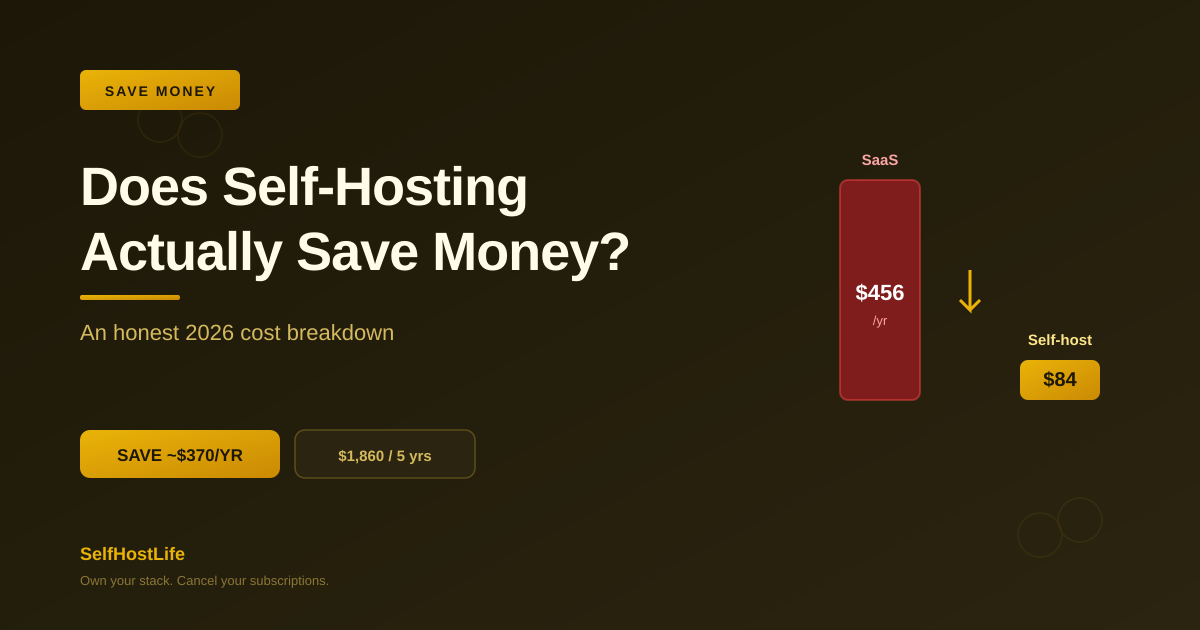
⚡ The Honest Answer
Yes — for most people, self-hosting saves real money, often $300-500/year once you replace several subscriptions. But it’s not free. You trade a monthly fee for hardware or VPS costs, a little electricity, and your time. This guide does the actual math, including the costs most articles conveniently skip.
Every self-hosting article promises savings — but does self-hosting save money once you count the hidden costs? Few articles show the real numbers, especially the easy-to-forget ones: electricity, hardware that wears out, and the hours you spend maintaining it. Let’s do the honest accounting, so you know exactly when self-hosting saves money and when it doesn’t.
Step 1: What You’re Actually Paying Now
Before calculating self-hosting costs, add up what you currently spend on subscriptions. Here’s a typical stack for someone who’d consider self-hosting:
| Subscription | Monthly | Yearly |
|---|---|---|
| Cloud storage (Dropbox 2TB) | $9.99 | $120 |
| Photo backup (Google One 2TB) | $9.99 | $120 |
| Password manager (1Password) | $2.99 | $36 |
| Notes (Notion Plus) | $10 | $120 |
| Media (Plex Pass) | $5 | $60 |
| TOTAL | ~$38 | ~$456 |
So our baseline is roughly $456/year. Your number may be higher or lower — but most people who consider self-hosting are spending $300-600/year on subscriptions like these. (Prices verified in 2026; check current vendor pricing, which changes often.)
For the full list of which self-hosted app replaces which subscription, see 10 self-hosted apps that replace SaaS.
Step 2: The Real Cost of Self-Hosting (Nothing Hidden)
Here’s where most articles get optimistic. Self-hosting has four real cost categories. Let’s count all of them.
Cost 1: The server (VPS or hardware)
- VPS option: A small cloud server runs about $4-6/month. Hetzner’s cheapest ARM instance is €3.79/month (about $4); Vultr and DigitalOcean start around $5-6. Call it ~$60/year.
- Home mini PC: A one-time purchase of $150-350. An N100 mini PC at ~$200 amortized over 5 years is about $40/year.
- Home NAS: A 2-bay NAS is ~$300 plus drives ($230-460). Amortized over 5 years, roughly $120-150/year — but you also get large local storage.
Cost 2: Electricity (home hosting only)
VPS users skip this entirely — the provider pays for power. For home hosting, the US average residential rate was 18.34 cents per kWh in June 2026 (EIA). Running a device 24/7:
- Mini PC (~10-15W): about $16-24 per year.
- 2-bay NAS (~30W with drives): about $48 per year.
Less than most people expect. A low-power mini PC costs roughly the price of one streaming subscription per year to keep running.
Cost 3: Backups
Non-negotiable, and often forgotten. Offsite backup storage (Backblaze B2 or similar) for a typical setup runs $1-3/month, or about $12-36/year. Skip this and a single disk failure can wipe out everything you ‘saved.’
Cost 4: Your time (the real hidden cost)
This is the cost no spreadsheet shows. Initial setup takes a few hours. Ongoing maintenance — updates, the occasional broken container, troubleshooting — averages maybe 1-3 hours per month. If you value your time at even $20/hour, that’s $240-720/year in opportunity cost. Whether that ‘counts’ depends on whether you enjoy it (many self-hosters consider it a hobby, not a chore).
⚠️ Be honest with yourself here. If tinkering with servers sounds like a fun weekend, the time cost is really a hobby you’d happily pay for. If it sounds like a chore, factor it in seriously — a $456/year subscription stack may be cheaper than 30 hours of work you’d resent.
Step 3: Three Real Scenarios
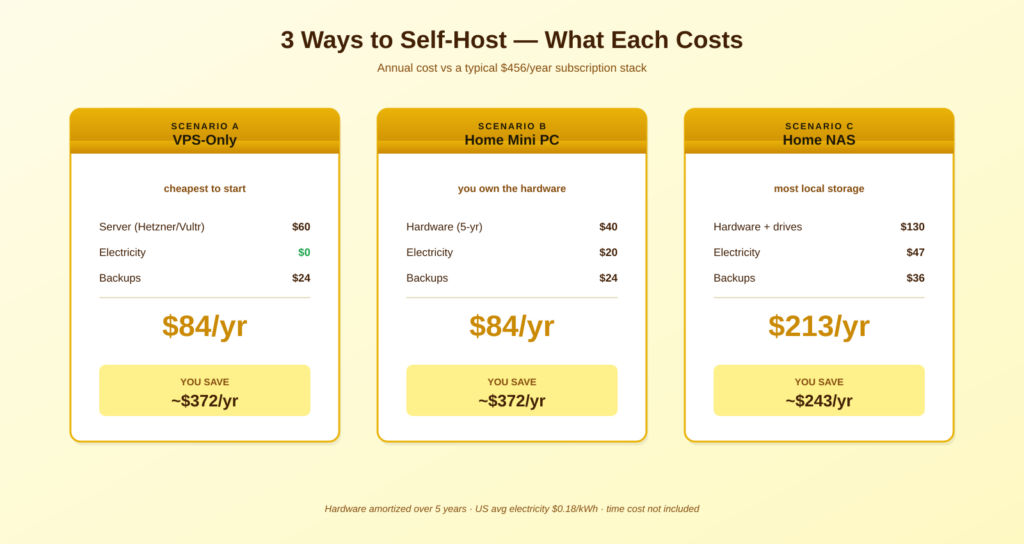
Scenario A: VPS-only (cheapest entry)
- Server: ~$60/year (Hetzner/Vultr)
- Electricity: $0 (provider pays)
- Backups: ~$24/year
Total: ~$84/year vs $456 in subscriptions = ~$372/year saved.
Scenario B: Home mini PC
- Hardware: ~$40/year (amortized $200 over 5 years)
- Electricity: ~$20/year
- Backups: ~$24/year
Total: ~$84/year vs $456 = ~$372/year saved — plus you own the hardware.
Scenario C: Home NAS (most storage)
- Hardware + drives: ~$130/year (amortized over 5 years)
- Electricity: ~$48/year
- Backups: ~$36/year
Total: ~$213/year vs $456 = ~$243/year saved — with terabytes of local storage included.
💡 Pattern: Every scenario saves money after year one. The VPS route is cheapest to start (no upfront hardware). The NAS route costs more but replaces large cloud-storage plans and keeps your data physically at home.
When Does Self-Hosting Save Money? The Break-Even Point
Hardware costs are upfront; subscription savings accrue monthly. So when do you actually come out ahead?
- VPS-only: Immediately. There’s no big upfront cost — you save from month one.
- Mini PC ($200): About 6-7 months. After that, pure savings for years.
- NAS ($300 + $300 drives): About 18-20 months. Longer, but you’re also getting storage you’d otherwise rent.
After the break-even point, the hardware is paid off and your effective monthly cost drops to just electricity and backups — often under $7/month for everything.
When Self-Hosting Does NOT Save Money
Honesty matters. Self-hosting is the wrong financial choice in these cases:
- You only pay for one cheap subscription. Replacing a single $3/month service with a $5/month VPS loses money. Self-hosting wins when it replaces several subscriptions at once.
- You’d hate the maintenance. If the time cost feels like a burden, the math flips. Your hours have value.
- You need guaranteed uptime. A business that loses money when a service is down should pay for managed reliability, not self-host on a home connection.
- You live somewhere with very expensive power. In Hawaii (~43¢/kWh) or parts of the Northeast (30¢+), home hosting electricity costs 2-3x the national average — though a VPS sidesteps this entirely.
If reliability matters but you still want to self-host, a VPS gives you datacenter uptime without home-internet worries, or managed hosting like Cloudways handles the server side for you.
The 5-Year Picture
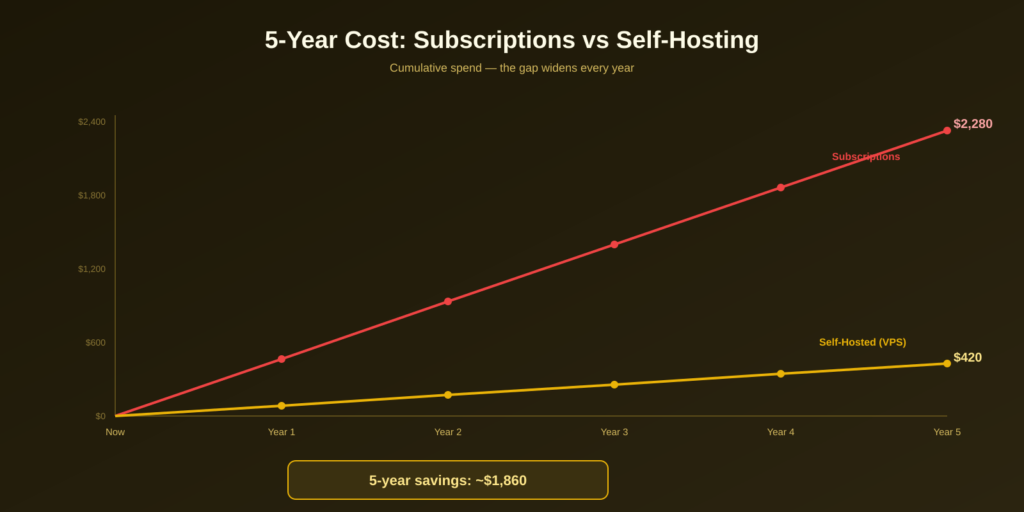
Money decisions are clearest over time. Here’s five years of subscriptions vs self-hosting (VPS scenario):
| Subscriptions | Self-Hosted (VPS) | |
|---|---|---|
| Year 1 | $456 | $84 |
| Year 2 | $912 | $168 |
| Year 3 | $1,368 | $252 |
| Year 5 | $2,280 | $420 |
| 5-yr savings | — | ~$1,860 |
Nearly $1,860 over five years, not counting your time. Even if you value maintenance time at $300/year, you’re still well ahead — and you own your data the entire time.
Frequently Asked Questions About Self-Hosting Costs
Is self-hosting really cheaper than subscriptions?
For most people replacing several subscriptions, yes. A typical $456/year subscription stack drops to about $84/year on a VPS — saving roughly $370/year, or $1,860 over five years. The savings shrink if you only replace one cheap service, or if you heavily value your maintenance time.
How much does electricity cost to run a home server?
Less than most expect. At the US average of 18.34 cents per kWh (EIA, June 2026), a low-power mini PC (10-15W) costs roughly $16-24 per year to run 24/7. A 2-bay NAS with drives (~30W) costs about $48 per year. VPS users pay nothing for electricity — the provider covers it.
What’s the cheapest way to start self-hosting?
A VPS. There’s no upfront hardware cost — you rent a small cloud server for about $4-6/month and start saving from month one. A Hetzner ARM instance at roughly $4/month is among the cheapest legitimate options in 2026.
How long until self-hosting pays for itself?
A VPS pays off immediately (no upfront cost). A $200 mini PC breaks even in about 6-7 months. A NAS with drives takes around 18-20 months but also replaces large cloud-storage plans and gives you local storage.
Does self-hosting include hidden costs?
Yes — three are commonly overlooked: electricity (for home hosting), offsite backups ($12-36/year), and your time for maintenance (1-3 hours/month). This guide counts all of them. Even with these included, self-hosting usually still comes out well ahead.
Is it worth self-hosting just to save money?
If pure savings is your only goal and you’d dislike the maintenance, a VPS replacing several subscriptions makes sense, but a home NAS may not. Most long-term self-hosters do it for a mix of savings, data ownership, and enjoyment of the hobby — the savings are the bonus, not the only reason.
Can self-hosting cost more than subscriptions?
Yes, in specific cases: replacing only one cheap subscription, living where electricity is very expensive and hosting at home, or valuing your maintenance time highly. Run your own numbers using your actual subscription total and local power rate before committing.
The Bottom Line — Run Your Own Numbers
💰 Takeaway: Self-hosting saves most people real money — around $370/year and nearly $1,900 over five years in the typical case. The cheapest, lowest-risk way to start is a VPS: no upfront hardware, no electricity cost, and you save from the first month. Home hardware costs more upfront but pays off within a year or two and gives you ownership.
But do the honest math for your situation. Add up your real subscriptions, check your local electricity rate, and be truthful about whether maintenance is a hobby or a chore. If you’re replacing several subscriptions and don’t mind a little tinkering, self-hosting is one of the best-value decisions in tech. If you’d replace just one cheap app and resent the upkeep, keep the subscription.
Ready to start cheaply? The $5 VPS self-hosting guide walks through the lowest-cost setup. Prefer to host at home? See the best mini PC and best NAS guides.
How These Numbers Were Calculated
This cost breakdown is based on:
- US average residential electricity rate of 18.34 cents/kWh — EIA Electric Power Monthly table 5.6.A, June 2026, checked 2026-08-30
- Measured power draw figures for low-power mini PCs (10-15W) and 2-bay NAS units (~30W)
- Current VPS pricing from Hetzner, Vultr, and DigitalOcean (2026)
- Subscription prices verified against vendor pricing pages in 2026
- 5-year hardware amortization for fair monthly comparison
Your actual costs will vary with your local electricity rate, hardware choices, and subscription mix — always run your own numbers.
Questions about your specific setup’s costs? Email hello@selfhostlife.com.
Product links on this site are plain links. We earn nothing from them — see our disclosure policy.