Cloud Storage Cost: Is Self-Hosting Cheaper Than Google Drive or Dropbox?
Cloud storage cost adds up fast: Google One, iCloud, and Dropbox bill you forever. Does self-hosting actually save money? The honest 5-year math for 2026.
⚡ The Honest Answer
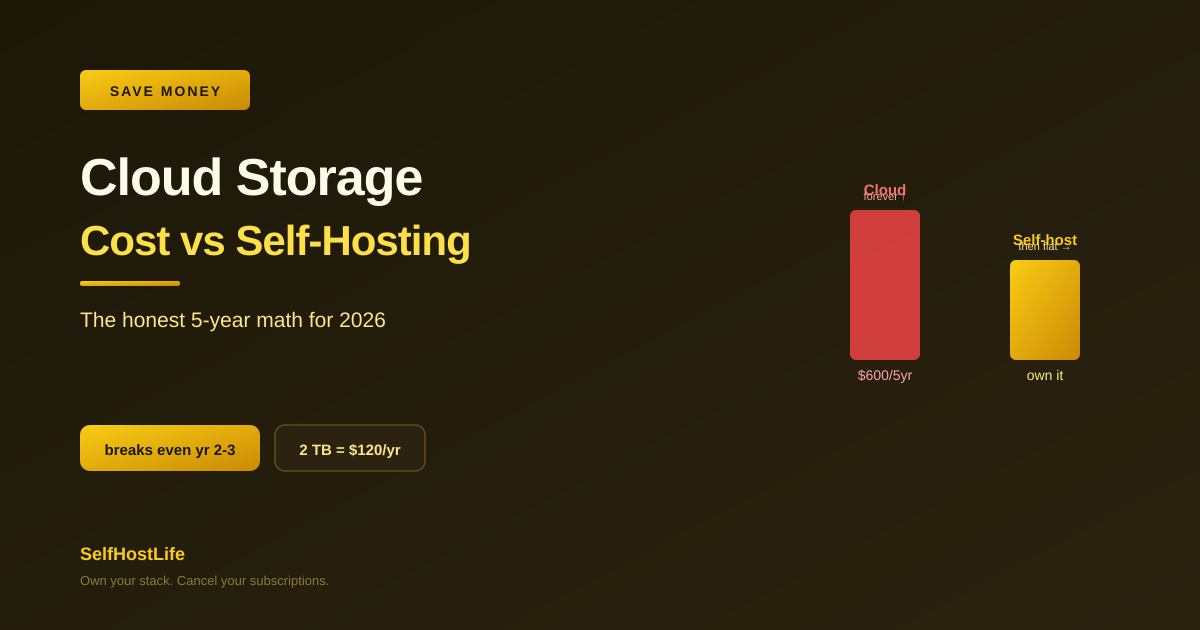
It is more nuanced than most self-hosting articles admit. Cloud storage cost is a subscription that never ends — 2 TB from Google One, iCloud, or Dropbox runs about $120 a year, forever. Self-hosting replaces that with an upfront hardware cost plus small running costs. But here is the honest catch: once you add proper offsite backup, the yearly cost of self-hosting alone is not dramatically lower than the subscription. The real savings appear when one box replaces several subscriptions at once — and when you value owning your data. This guide does the real math, without the hype.
Here’s the uncomfortable truth about cloud storage cost: you never stop paying it. That $9.99 a month for 2 TB feels small, but it’s rent — miss a payment and you lose access, and the meter runs forever. Self-hosting replaces that endless rent with something you own. But is it actually cheaper once you count hardware, electricity, and backups? Let’s do the honest math for 2026, including the costs most ‘just self-host it’ articles conveniently skip.
What Cloud Storage Actually Costs in 2026
The big three consumer providers have converged on nearly identical pricing for the popular 2 TB tier. Here’s what you pay — and keep paying:
| Service (2 TB) | Per month | Per year | Over 5 years |
|---|---|---|---|
| Google One | $9.99 | $119.88 | ~$600 |
| iCloud+ | $9.99 | $119.88 | ~$600 |
| Dropbox Plus | $9.99 | $119.88 | ~$600 |
| OneDrive (1 TB + M365) | $6.99 | $83.88 | ~$420 |
So the popular 2 TB plans cost roughly $120 a year, or about $600 over five years — and that’s if prices never rise (they tend to). Need more than 2 TB, or want a family’s photos and videos backed up? The meter climbs from there. This is the number self-hosting has to beat.
One caveat on the Google row, added 31 August 2026. Those were the standard 2 TB prices when this comparison was built, and they still describe iCloud+ and Dropbox. Google has since stopped selling a plain 2 TB tier under the Google One name — consumer storage is now bundled into its AI plans (Basic, AI Plus, AI Pro, AI Ultra), and the plan formerly called AI Premium is now AI Plus. Google’s pricing page returns local currency by region, so rather than guess at a current US dollar figure I have left the older one in place and dated it. Check the Google One plans page for your own country before you rely on the Google line.
What Self-Hosting Actually Costs
Self-hosting swaps the endless subscription for an upfront hardware cost plus small running costs. Being honest, here’s everything that goes into it — including the parts skipped by articles that just say ‘run Nextcloud and save money’:
- The device (one-time). A mini PC or a Raspberry Pi to run the storage. Figure $130-300 depending on choice. A used mini PC can be less.
- Storage drives (one-time). The actual disks. A 4 TB SSD or a couple of hard drives run roughly $100-250. Buy more than you need now.
- Electricity (ongoing). A low-power server drawing 10-25 watts costs about $16-40 a year to run 24/7 at the US average of 18.34¢/kWh — genuinely small.
- Offsite backup (ongoing). The cost most people forget. Your data needs a backup somewhere else — cheap object storage like Backblaze B2 runs about $6 per TB per month. For a couple of TB, call it $10-15 a month, or $120-180 a year.
⚠️ The backup cost is not optional. This is where ‘self-hosting is free’ falls apart. If your only copy lives on a drive at home, one failure or fire wipes it out — something cloud providers protect you from automatically. A proper offsite backup is essential, and it’s an ongoing cost that eats into the savings. Any honest comparison has to include it. See the 3-2-1 backup guide for why.
The Crossover: When Self-Hosting Wins
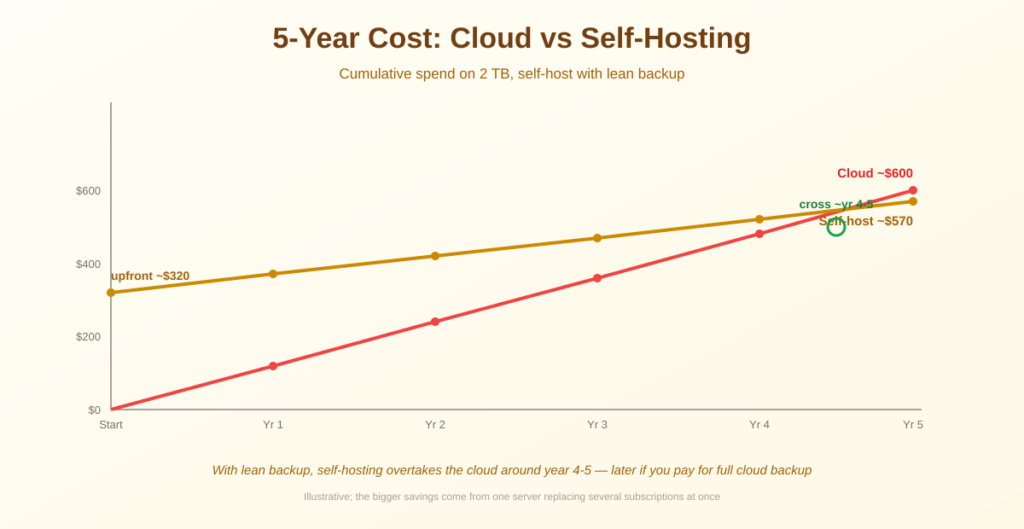
Here is where honesty matters. A self-hosted 2 TB setup costs roughly $300-500 upfront, then an ongoing amount for electricity ($16-40 a year) and — if you back up properly to the cloud — offsite storage. That offsite backup is the twist: cheap object storage still costs money, so your yearly self-hosting cost can land close to the ~$120 cloud subscription it replaces.
So does storage-only self-hosting crush the cloud on price? Not dramatically, if you back up honestly. Where it wins on money is when you keep backup lean (a second local drive plus occasional offsite, rather than mirroring everything to paid cloud) — or, far more importantly, when the same server does several jobs at once.
- Years 1-2: the cloud is cheaper and vastly easier. Your hardware hasn’t paid for itself yet.
- Years 3-5: if you keep backup costs modest, the lines cross and self-hosting edges ahead. If you pay for full cloud backup of everything, the two stay roughly even on pure storage cost.
- The multiplier: run photos, passwords, and a media server on the same box, and one hardware cost replaces several subscriptions — that’s where the economics tilt decisively.
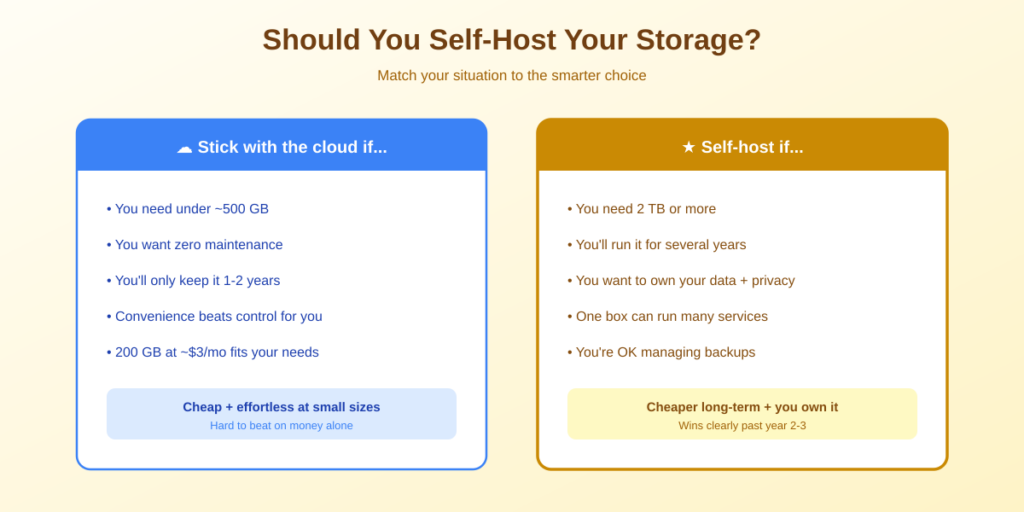
💡 The honest tipping point: Storage alone is often close to a wash on money once you include real backup. The decisive win is bundling: if one server replaces a cloud storage plan plus a photo plan plus a password manager, the shared hardware cost beats paying for each separately. If you only need 200 GB and one service, the cloud at ~$3 a month is very hard to beat — at that size, self-host for control and privacy, not savings.
It Was Never Only About Money
Here’s the honest framing: for small storage needs, the pure cloud storage cost math is close, and convenience often wins. The reason most people self-host storage isn’t only the dollars — it’s what the dollars buy:
- You own your data. No company can raise your rent, change terms, scan your files, or lock your account and hold your photos hostage.
- Privacy. Your family photos and documents sit on your hardware, not on a server being mined for training data or ads.
- No artificial limits. Add a bigger drive and you have more space — no upgrading to the next pricing tier for one extra gigabyte.
- One cost, many services. The same box that stores files can also run your photos, password manager, and media server — spreading the cost across everything you’d otherwise subscribe to separately.
That last point is the real economic case: see does self-hosting save money for the whole-stack picture.
If You Decide to Self-Host Your Storage
The tools that replace each cloud service are mature and free:
- Nextcloud replaces Google Drive and Dropbox — files, sync, sharing, and collaboration.
- Immich replaces Google Photos — automatic phone photo backup with AI search and albums.
Run either on a mini PC or NAS, put it behind HTTPS with a reverse proxy, and back it up offsite. That’s the whole stack — and it’s the same hardware doing multiple jobs, which is what tips the economics in self-hosting’s favor.
Start with Nextcloud for files or Immich for photos, on a mini PC.
Frequently Asked Questions About Cloud Storage Cost
Is self-hosting cheaper than paying for cloud storage?
It’s more nuanced than a simple yes. Cloud storage costs about $120 a year for 2 TB forever, while self-hosting is a one-time hardware cost (roughly $300-500) plus ongoing electricity and offsite backup. If you pay for full cloud backup, your yearly cost lands close to the subscription, so storage alone isn’t dramatically cheaper. Self-hosting wins clearly when you keep backup lean or, more importantly, run several services on one box so a single hardware cost replaces multiple subscriptions.
How much does cloud storage cost in 2026?
For the popular 2 TB tier, Google One, iCloud+, and Dropbox all charge about $9.99 a month, or $119.88 a year — roughly $600 over five years. OneDrive is $6.99 a month for 1 TB but includes Microsoft 365. Google has since moved its consumer storage into its AI plans, so check its current pricing for your country. Smaller tiers are cheap: iCloud+ 200 GB is just $2.99 a month, which is very hard to beat by self-hosting on cost alone.
What’s the real cost of self-hosting storage?
Three parts: a one-time device (mini PC or Pi, $130-300), one-time drives ($100-250 for a few TB), and ongoing costs of electricity ($15-35 a year) plus essential offsite backup ($120-180 a year for a couple of TB on Backblaze B2). The backup is the cost most guides skip, and it’s the one that makes an honest comparison fair.
Do I really need to pay for backup if I self-host?
Effectively yes. Cloud providers back up your data automatically across data centers; when you self-host, that responsibility is yours. Without an offsite backup, a single drive failure, theft, or fire destroys your only copy. Cheap object storage like Backblaze B2 (about $6 per TB per month) is the standard solution, and its cost must be counted in any real savings comparison.
At what point does self-hosting storage pay for itself?
It depends heavily on your backup approach. If you keep backup costs modest, a 2 TB setup can break even around year 3-4, after which you’re ahead. But if you pay for full cloud backup of everything, the ongoing cost stays close to the subscription and pure storage may never dramatically pull ahead. The clearest payoff comes from running multiple services on the same server, which spreads one hardware cost across several subscriptions you’d otherwise pay separately.
Is it worth self-hosting if I only need a little storage?
On money alone, usually not. If 200 GB is enough, iCloud+ or Google One at around $3 a month is very hard to beat once you count hardware, electricity, and backup. At small sizes, self-host for control, privacy, and avoiding data mining — not to save a few dollars. The cost case gets compelling at 2 TB and up, kept over several years.
Can one self-hosted server replace multiple subscriptions?
Yes, and that’s the strongest economic argument. The same mini PC that stores your files with Nextcloud can also run Immich for photos, Vaultwarden for passwords, and a media server — replacing several separate subscriptions at once. Spreading one hardware cost across many services is what tips the overall economics decisively in self-hosting’s favor.
The Bottom Line
💰 Takeaway: Cloud storage cost is rent you pay forever — about $120 a year for 2 TB, $600 over five years. Self-hosting trades that for an upfront hardware cost plus small running costs. But be honest with yourself: once you add proper offsite backup, storage alone isn’t dramatically cheaper than the subscription. The decisive win comes from bundling — one server running your files, photos, passwords, and media at once, so a single hardware cost replaces several subscriptions. For small needs, the cloud wins on money and ease. But at 2 TB or more, kept for years, with one box doing many jobs, self-hosting comes out ahead — and you own your data on top.
Ready to run the numbers for real? Pair Nextcloud with a proper backup strategy, and check the power cost so there are no surprises.
How This Guide Was Researched
- Subscription pricing (iCloud+ / Dropbox 2 TB at $9.99/mo, OneDrive 1 TB $6.99/mo with M365) verified across multiple current sources. The Google figure is the pre-restructure price: as of 31 August 2026 one.google.com serves prices in local currency by region, so a current USD number could not be sourced from here and has not been invented
- Self-hosting hardware ranges, home-server power draw (10-25 W, ~$15-35/yr), and offsite backup pricing (Backblaze B2 ~$6/TB/mo) cross-referenced across independent 2026 guides
- The break-even analysis reflects a standard upfront-vs-recurring cost model, honestly including the backup cost that many comparisons omit
- The smaller-tier caveat (200 GB cloud plans being hard to beat) drawn from current per-GB pricing across providers
Subscription prices change often — check each provider’s official pricing page before deciding. The Google One plans page lists current tiers.
Questions about your setup? Email hello@selfhostlife.com.
Product links on this site are plain links. We earn nothing from them — see our disclosure policy.