Jellyfin vs Plex 2026: The Honest Comparison
Jellyfin vs Plex in 2026 — after Plex's price hikes and remote streaming paywall, which media server wins? An honest comparison for self-hosters.
⚡ Quick Verdict
Jellyfin vs Plex in 2026 comes down to money versus polish. Jellyfin is completely free — remote streaming, hardware transcoding, everything. Plex is more polished but now requires a paid pass for remote streaming, and its Lifetime Pass tripled to $749.99 on July 1, 2026. For most self-hosters starting today, Jellyfin is the better default. Plex still wins for non-technical households that value its app ecosystem.
The Jellyfin vs Plex debate changed fundamentally in 2025-2026. Plex raised prices for the first time in a decade, put remote streaming behind a paywall, and tripled its Lifetime Pass from $249.99 to $749.99 on July 1, 2026. Meanwhile Jellyfin — the free, open-source alternative — kept shipping stable releases with zero paywalls. Here’s the honest comparison, including where Plex still genuinely wins.
What Changed: Plex’s 2025-2026 Price Timeline
To understand why this comparison looks different than it did two years ago, here’s what Plex officially announced:
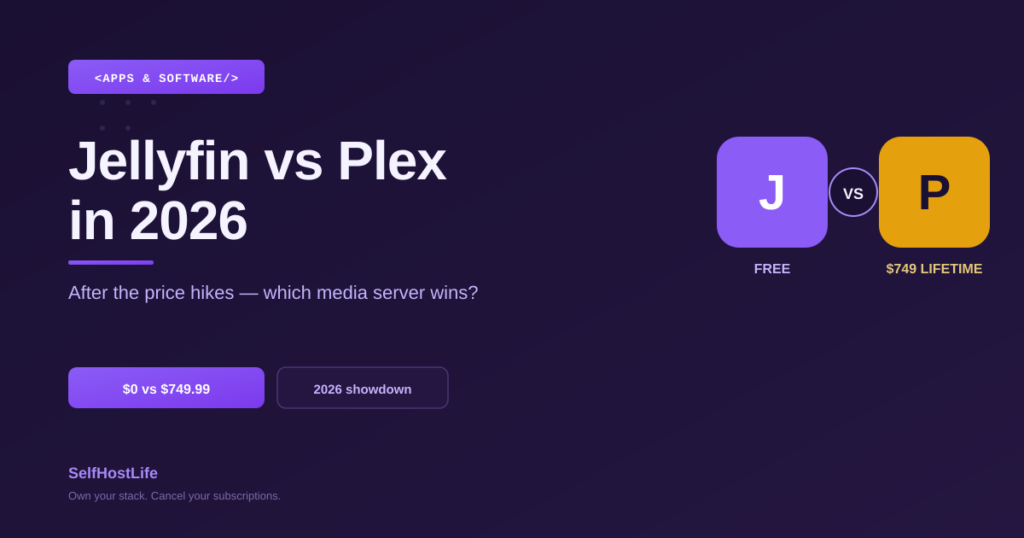
- April 29, 2025: Plex Pass rose from $4.99 to $6.99/month, $39.99 to $69.99/year (a 75% jump), and Lifetime from $119.99 to $249.99. Remote streaming — free for Plex’s entire history — moved behind a paywall.
- April 2025: A new ‘Remote Watch Pass’ launched at $1.99/month for people who just want to stream remotely without full Plex Pass features.
- June 1, 2026: Remote Watch Pass rose 50% to $2.99/month ($29.99/year).
- July 1, 2026: Lifetime Plex Pass tripled to $749.99, as announced. Existing lifetime holders kept their benefits unchanged.
- As of August 2026: a 5 Year Plex Pass sits at $249.99 — the old Lifetime price, now buying five years instead of forever.
Local playback on your home network remains free on Plex. The paywall applies to streaming away from home — which, for many self-hosters, is the entire point of running a media server.
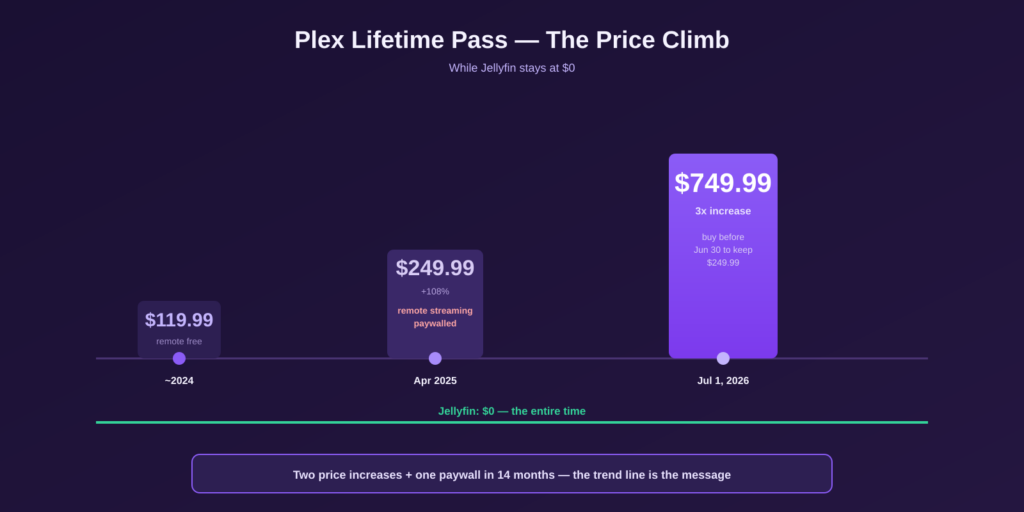
⏰ That deadline has passed. The $249.99 Lifetime price ended on June 30, 2026, and Lifetime is $749.99 as of August 2026. What took its place is a 5 Year Plex Pass at $249.99 — the same number, buying five years rather than forever. Three of them back to back come to $749.97, so Plex has effectively repriced "lifetime" as fifteen years.
Jellyfin vs Plex: Head-to-Head
| Jellyfin | Plex | |
|---|---|---|
| Price | Free, forever | $6.99/mo · $69.99/yr · $249.99/5yr · $749.99 lifetime |
| Remote streaming | Free | Paid (Pass or Watch Pass) |
| Hardware transcoding | Free | Requires Plex Pass |
| Open source | Yes (100%) | No (proprietary) |
| Account required | No — fully local | Yes (plex.tv account) |
| Client apps polish | Good, improving | Excellent, everywhere |
| Remote access setup | DIY (reverse proxy/VPN) | Built-in, zero config |
| Easy sharing w/ family | Manual accounts | Polished invites |
Where Jellyfin Wins
- Everything is free. Remote streaming, hardware transcoding, all clients, all features. There is no premium tier because there is nothing to upsell. What Plex charges $6.99/month for, Jellyfin includes.
- No account, no phone-home. Jellyfin runs entirely on your hardware. No plex.tv login, no external dependency, no company that can change the terms later. Your server keeps working even if the Jellyfin project disappeared tomorrow.
- Open source momentum. Plex’s 2025-2026 changes drove a visible migration wave. Jellyfin’s development pace has accelerated, with the client apps improving noticeably.
- Immune to future price changes. The pattern matters: Plex raised prices twice in just over a year and paywalled a previously free feature. Jellyfin structurally cannot do this to you.
Where Plex Still Wins (Honest)
- Client app quality. Plex apps exist on virtually every TV, console, and streaming stick, and they’re polished. Jellyfin’s clients are good and improving, but some smart TV platforms still have rough edges.
- Zero-config remote access. Plex handles remote streaming setup for you — sign in and it works. Jellyfin requires you to set up a reverse proxy with HTTPS or a VPN like Tailscale yourself. It’s not hard, but it is a real step.
- Sharing with non-technical family. Plex’s invite system is genuinely easier for grandparents and friends. With a server owner’s Plex Pass, invited users stream remotely at no extra charge.
- Extras. Skip-intro, polished music handling, metadata richness, and integrations are still ahead of Jellyfin in places.
If you’re setting up Jellyfin remote access, my server security guide covers the reverse-proxy and Tailscale approaches step by step.
The Cost Math: Jellyfin vs Plex Over 5 Years
- Jellyfin: $0. Five years, ten years — still $0.
- Plex monthly: $6.99 × 60 months = $419.40 over 5 years.
- Plex annual: $69.99 × 5 = $349.95 over 5 years.
- Plex 5 Year at $249.99: $50 a year, so it beats buying five annual passes ($349.95) outright. If you are staying on Plex at all, this is the tier that makes sense.
- Plex Lifetime at $749.99: breaks even against annual at about 10.7 years, and against three consecutive 5 Year passes at almost exactly fifteen. Hard to justify unless you are confident about a decade and a half.
Both run on the same hardware — see my best NAS for Plex guide (the recommendations apply equally to Jellyfin, with one bonus: Jellyfin’s hardware transcoding doesn’t need a paid pass).
Which Should You Pick? Jellyfin vs Plex Decision Guide
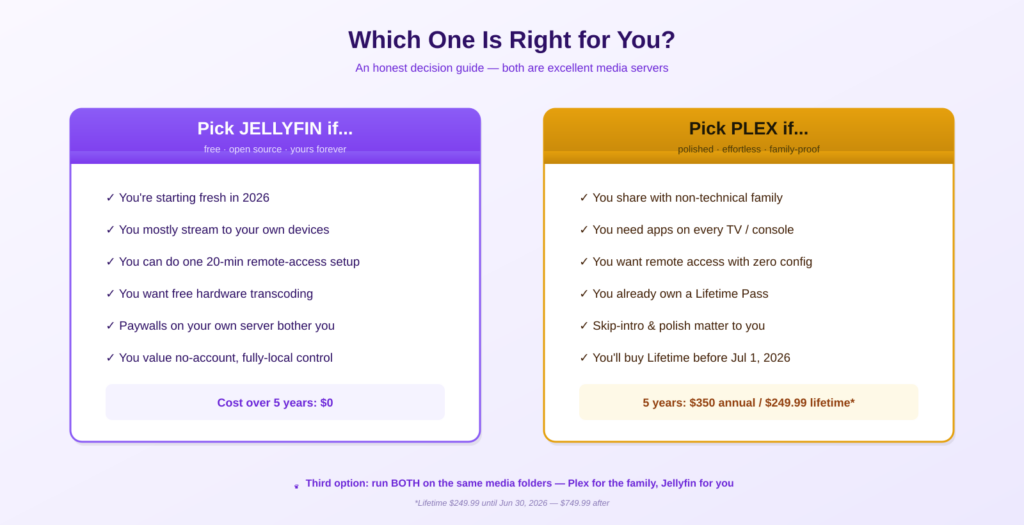
Pick Jellyfin if: you’re starting fresh in 2026, you’re comfortable doing a one-time remote-access setup, you mostly stream to your own devices, or the principle of paywalled features on your own server bothers you.
Pick Plex if: you share with non-technical family across many device types, you want remote streaming working in five minutes with zero config, or you already own a Lifetime Pass (grandfathered — nothing changes for you).
Run both (genuinely viable): they can share the same media folders on one server. Many self-hosters keep Plex for the family and use Jellyfin themselves. Zero conflict, and you can migrate gradually.
Frequently Asked Questions: Jellyfin vs Plex
Is Jellyfin really completely free?
Yes. Jellyfin is 100% free and open source — remote streaming, hardware transcoding, all client apps, every feature. There is no premium tier. It’s funded by donations and developed by volunteers.
Why did Plex put remote streaming behind a paywall?
In March 2025 Plex announced that from April 29, 2025, streaming your personal media remotely requires a paid plan (Plex Pass, or the cheaper Remote Watch Pass). Plex cited rising costs. Local playback on your home network remains free.
How much does Plex cost in 2026?
As of August 2026: $6.99/month, $69.99/year, $249.99 for five years, or $749.99 lifetime. The Lifetime price tripled from $249.99 on July 1, 2026, and the $249.99 figure now buys the new 5 Year Pass instead. The Remote Watch Pass, which covers remote streaming only, is $2.99/month or $29.99/year.
Is Jellyfin harder to set up than Plex?
The server install is equally easy — both are one-click on most NAS units and simple Docker containers. The real difference is remote access: Plex works out of the box, while Jellyfin needs a reverse proxy with HTTPS or a VPN like Tailscale, which takes 15-30 minutes once.
Can I run Jellyfin and Plex at the same time?
Yes, and it’s a popular setup. Both can point at the same media folders on the same server without conflict. Many people keep Plex for sharing with family while using Jellyfin personally, then migrate fully once Jellyfin covers their needs.
Does Jellyfin support hardware transcoding for free?
Yes — this is a major difference. Jellyfin’s hardware transcoding (Intel Quick Sync, NVIDIA, AMD) is completely free. Plex locks hardware transcoding behind the paid Plex Pass.
Is the Plex Lifetime Pass still worth it at $749.99?
For almost nobody. At $749.99 it breaks even against the annual plan at about 10.7 years, and against three consecutive 5 Year passes at almost exactly fifteen. The 5 Year Pass at $249.99 is the tier that pays for itself — $50 a year against $69.99 — and it caps your exposure if Plex reprices again, which it has done twice since 2025.
The Bottom Line
💡 Verdict: In 2026, Jellyfin is the better default for new self-hosters — free remote streaming, free hardware transcoding, no account, no future price-hike risk. Plex remains the right choice for households that prize its polished apps and effortless family sharing, and existing Lifetime holders should happily stay. If you do want Plex long-term, the 5 Year Pass at $249.99 is now the sensible tier — Lifetime at $749.99 only pays off past fifteen years.
Setting up your first media server? Start with the best NAS guide, lock it down with the security guide, and see what else your server can replace in 10 self-hosted apps.
How This Comparison Was Researched
- All Plex pricing verified against Plex’s official announcements (March 2025 and May 2026) and cross-checked with 9to5Mac, TechRadar, and Tom’s Guide coverage
- Remote Watch Pass June 2026 price change confirmed across multiple independent reports
- Jellyfin feature claims verified against the official Jellyfin documentation
- Both servers tested on the same hardware referenced in my NAS guide
All Plex prices above were checked directly on plex.tv on August 29, 2026. Plex has repriced twice since 2025, so verify before purchasing. Neither Plex nor Jellyfin has an affiliate program; this comparison earns nothing either way, which is exactly how a comparison should work.
Questions? Email hello@selfhostlife.com
Product links on this site are plain links. We earn nothing from them — see our disclosure policy.